The trades
Built from the field.
Bart began studying masonry and apprenticing in tile installation in 1988. Years of installation and custom fabrication shaped the way Texcrete approaches every layer of a project.
Bart began masonry training and a tile apprenticeship in 1988. That trade background is the foundation of Texcrete Designs.
Years of tile installation taught him to look beyond the finished surface: substrates, preparation, waterproofing, drainage, transitions and the details that determine whether an assembly performs.
That experience expanded into GFRC countertops, custom fabrication and microcement installation. Today, it guides the way Texcrete develops Microtex components and teaches contractors through Microcement US.
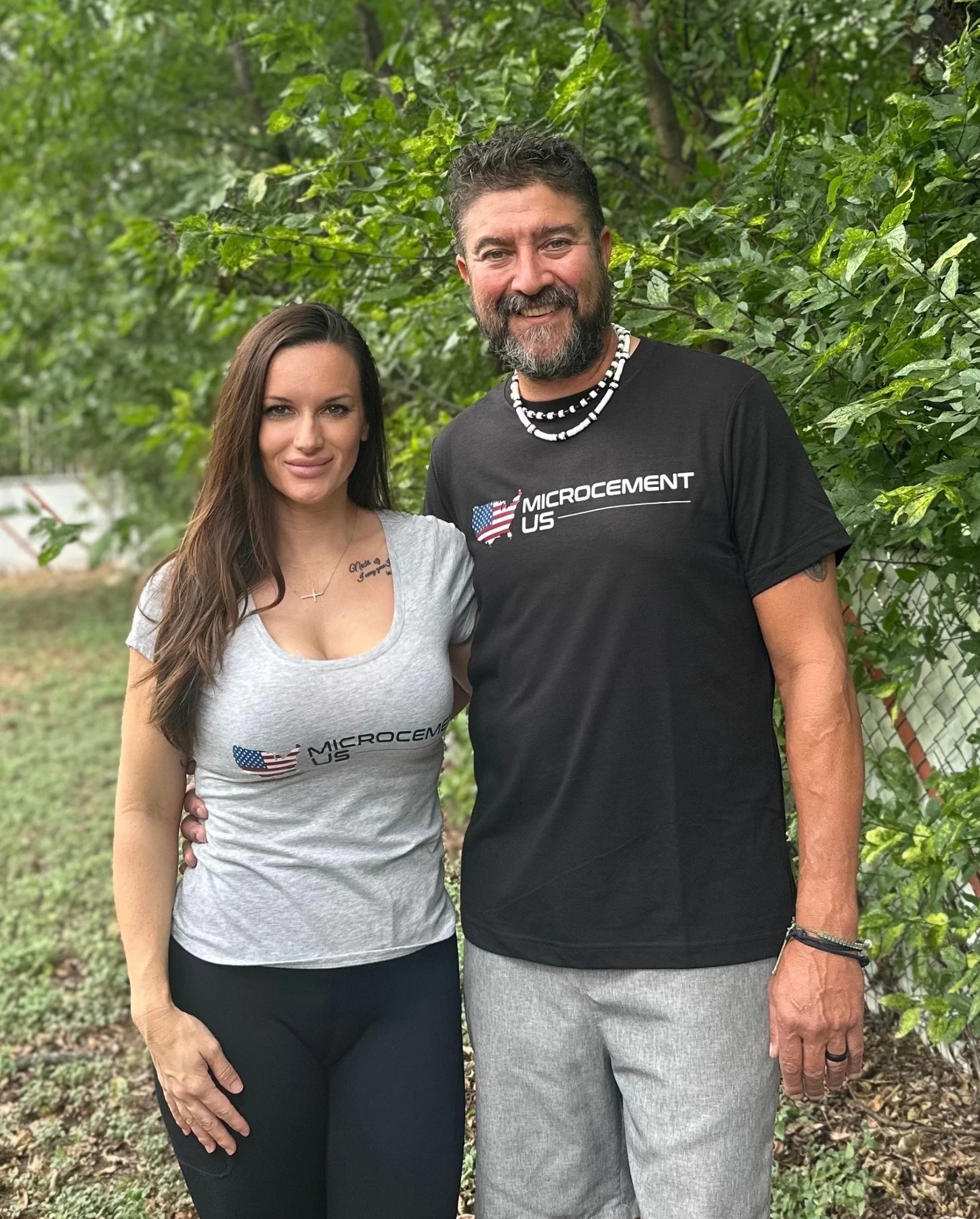
Texcrete Designs grew from Bart’s years in the trades and his commitment to understanding microcement from the ground up. Today, that work is a shared effort with his wife, Haily.
Since becoming involved three years ago, Haily has become an essential part of Texcrete. She works on installations, manages social media, and brings extensive knowledge of the installation process to the company’s hands-on training program.
Training is where their teamwork really shows. Haily is deeply involved in the program, and past students have specifically complimented how well she and Bart work together. Their combined experience helps connect classroom instruction with the realities of an actual installation.
Their partnership began with a first date that lasted a week. Today, they work side by side—building Texcrete, teaching contractors, and putting their experience into the products and projects they create together.
Bart began studying masonry and apprenticing in tile installation in 1988. Years of installation and custom fabrication shaped the way Texcrete approaches every layer of a project.
Our hands-on training connects preparation, shower construction, application, finishing and troubleshooting with the realities of working in microcement.
Explore professional training →Recurring installation challenges led to shop-fabricated shower trays, benches, curbs, vanities and custom forms—developed from the installer’s side of the problem.
Explore Microtex →Every great finish begins long before the finish.
That belief has guided the way Bart Randolph installs, teaches, develops products, and builds Texcrete Designs.
Bart Randolph’s career in the trades began in 1988, while attending vocational high school and studying masonry. At the same time, he began an apprenticeship in tile installation—putting a trowel in his hand both in the classroom and on actual jobsites.
What followed was decades of hands-on work. Tile installation became the foundation of his career, building an understanding of substrates, preparation, waterproofing, layout, drainage, transitions and the details that determine whether an installation performs long after the job is finished.
Over the years, that experience expanded into GFRC countertops, custom fabrication and increasingly specialized architectural work. Each discipline added another layer of knowledge—not just about how to create a finished surface, but how everything underneath it has to work together.
Eventually, that path led to microcement.
That background still shapes the company today. Bart understands what it means to solve problems in the field, work with imperfect conditions, meet a schedule, protect the work beneath the finish, and put his name behind the final result.
That experience became the foundation of Texcrete Designs.
Bart has never been particularly interested in doing something a certain way simply because that is how it has always been done.
When something works, he wants to understand why. When something fails, he wants to understand the cause. When a process is unnecessarily difficult, the next question is usually simple: is there a better way?
Sometimes the answer is no. Sometimes it means changing a process. Sometimes it leads to a product that did not exist before.
Innovation was never the original business plan. It became the natural result of continually questioning, testing, and improving the work.
“When I started working seriously with microcement in the United States, there was nobody here I could simply call and ask how to solve every problem.”
Microcement had a much deeper history in Europe than it did in the United States. But importing a product did not automatically import decades of local construction knowledge.
European construction methods, substrates, shower assemblies, and jobsite conditions can be different from what contractors encounter across the United States. There was no mature American knowledge base that answered every question Bart was facing in the field.
So he learned the hard way: through real projects, testing, experimentation, callbacks, successful installations, failures, conversations with manufacturers, and thousands of hours of hands-on work.
Every project added another piece to the system. How should the substrate be prepared? Where does waterproofing actually belong in the assembly? How should transitions be handled? What happens when movement is ignored? Which details matter most in a wet area?
Those lessons became far more valuable than any single finish technique.
To give today’s contractors the resources I wish had existed when I started.
That idea explains much of what Texcrete has become.
Once Bart had accumulated the knowledge he wished someone had been able to give him, keeping it to himself made little sense.
Microcement US was developed around a different training philosophy: teach the complete installation, not just the visible finish. Contractors work through preparation, reinforcement, waterproofing principles, application, finishing, sealing, shower construction, troubleshooting, estimating, and business realities.
The goal is not for someone to leave knowing how to make a sample board. The goal is for them to leave understanding enough of the complete system to make better decisions on a real jobsite—and to have continued access to Bart when questions come up afterward.
Training exposed the same challenges repeatedly. Installation work revealed them even more clearly. Certain parts of the job consumed time, introduced unnecessary variables, or depended too heavily on field fabrication.
That led to prototyping.
Shower trays. Benches. Curbs. Vanities. Custom forms. CNC-cut EPS components. Reinforcement details. Drain transitions. Shipping methods. Each idea started with the same question: can we make this easier for the installer without compromising the finished system?
Those prototypes became Microtex—a product line developed from the installer’s side of the problem.
Those roles were not mapped out in advance. One led naturally to the next.
Installation created experience. Experience created knowledge. Knowledge created education. Repeated field problems created product ideas. Product ideas created manufacturing.
Today Texcrete Designs brings those pieces together under one company: Microtex products, Microcement US training, CimentArt materials, technical resources, and continued real-world application.
Texcrete still thinks like an installer because every product ultimately has to work for the person carrying it onto the jobsite and standing behind the finished result.
Bart’s goal is not simply to be remembered for building a successful company. It is to be remembered for helping raise standards in an industry he genuinely cares about.
His work has been featured by HGTV, HGTV.com, Austin Home Magazine, and The Wall Street Journal. But the reputation Texcrete is building is grounded more fundamentally in the work itself: tell contractors the truth, teach what matters, keep learning, and never cut corners for convenience.
Microcement in the United States is still evolving. Texcrete intends to keep evolving with it—developing better products, documenting better methods, improving professional education, and sharing the knowledge earned along the way.
We do not believe innovation comes from chasing trends. It comes from solving real problems for the people doing the work.
That is what drives Texcrete today, and it is what will continue to drive the company forward.